
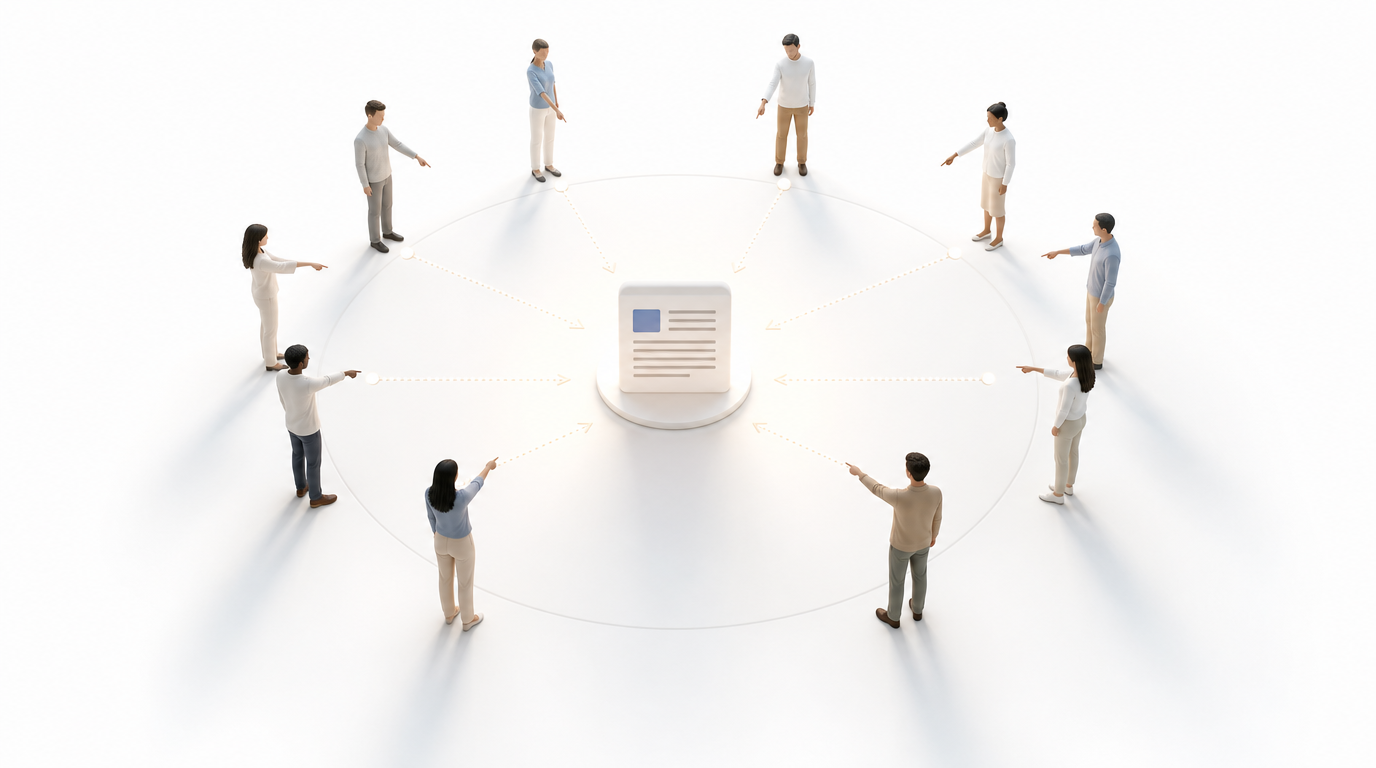
There is one thing about your website you cannot do yourself. You can write every page. You can choose every word, fix every heading, structure every bit of it until it is exactly what you meant. And none of that answers the question that search engines and AI systems are actually asking, which is: does anyone else think this site is worth pointing at?
That is what a backlinkBacklink: A link on someone else's site pointing to yours — the one signal about your website you cannot create yourself. Read the full entry in the glossary.BacklinkA link on someone else's site pointing to yours — the one signal about your website you cannot create yourself.Read full entry is. A link on someone else's website that points to yours. Not a link you placed. A link someone else placed.
The distinction matters more than it sounds. Everything else on your site is a claim you are making about yourself. A backlink is a claim someone else made about you. That is why it carries weight, and that is also why it is the hardest thing on this list to get.
What a backlink actually does
Search engines have always had a hard problem. Ten pages say roughly the same thing about roughly the same topic. Which one goes first?
Reading the pages only gets you so far. Anyone can write a confident page. So search engines started looking at something harder to fake: who links to whom. If a well-established site links to yours, that is a small piece of evidence that yours is worth reading. Enough of those, from sources that themselves are trusted, and your page starts to look like the one that should go first.
That is the entire mechanism. It has been the entire mechanism since the late nineties, and despite everything that has changed since, it has not gone away.
Two details are worth knowing, and then you can stop thinking about the machinery.
The second is that some links are marked, in the code of the page, as not countingNofollow: A marker on a link telling search engines not to count it as a recommendation — the link still works, it just carries no endorsement. Read the full entry in the glossary.NofollowA marker on a link telling search engines not to count it as a recommendation — the link still works, it just carries no endorsement.Read full entry. Most links on social media work this way. So do most links in forum posts and comment sections. The people who run those platforms got tired of being farmed for links, so they told search engines to ignore them. Those links still send you real visitors, and they still put your name in front of people. They just do not move you up the rankings.
None of this requires you to do anything technical. You are not going to be editing anyone else's code. But it explains why a hundred links can be worth less than one, which is the part that trips people up.
Why this now matters twice
Here is what changed. For twenty-five years, backlinks mattered because of Google. Now they matter for a second reason, and the second reason works slightly differently.
When someone asks an AI assistantAnswer Engine: An answer engine is a tool that responds to your question with a direct answer instead of a list of links to click — like ChatGPT, Perplexity, or the AI summaries now sitting at the top of Google. Read the full entry in the glossary.Answer EngineAn answer engine is a tool that responds to your question with a direct answer instead of a list of links to click — like ChatGPT, Perplexity, or the AI summaries now sitting at the top of Google.Read full entry about a problem you happen to solve, the system pulls together an answer from what it has read. Sometimes it retrieves live pages. Sometimes it draws on what it absorbed during training. Either way, the question underneath is the same one: which sources are worth drawing from?
Links feed into that. But so does something looser, which is simply being mentioned. If three or four credible sites in your field discuss what you do, an AI system reading the web has encountered your name in a context that makes sense. It has some idea of what you are and where you fit. If nobody has ever written about you anywhere, the system has your own website and nothing else. And a system that has only your own account of yourself has no way to weigh it.
This is why the modern version of this work is a little broader than the old version. You are not only chasing links now. You are trying to exist in other people's writing. A mention without a link still counts for AI systems in a way it never quite did for search engines.
The industry that sells you the wrong thing
Search for how to get backlinks and you will find, within about thirty seconds, someone selling them. Five thousand backlinks for forty dollars. Automated software that builds links while you sleep. Packages, tiers, dashboards with numbers going up.
I want to be careful here, because the usual warning about this is out of date and the out-of-date version is less useful than the truth.
The old warning was that buying links would get you penalised. That was accurate for years. Google spent a long time actively punishing sites with obviously purchased link profiles, and a lot of businesses got badly hurt.
What happens now is different and, in a way, worse. Google has mostly stopped punishing and started ignoring. The systems got good enough at recognising the pattern that the links simply do not register. They are not counted against you. They are not counted at all.
So the honest objection to buying backlinks is not that it is dangerous. It is that you are paying for nothing. The dashboard fills up. The number goes up. Nothing happens, because nothing was ever going to happen, because the thing you bought was never the thing that works.
And it is worth being clear about why these links are so cheap. They come from sites built for no purpose other than holding links. Nobody reads them. No editor chose to include you. A machine put your name on a page that a machine generated, and the whole arrangement is visible for what it is to anyone looking, including the systems that are looking.
The tell is always the same. If a link required no judgement from a human being, it carries no judgement, and judgement is the entire point.
What good actually looks like
A good backlink has three properties, and you can check all three without any tools.
Somebody chose to include it. A person decided your thing was worth pointing their readers toward. That decision is the signal. Everything else follows from it.
It comes from somewhere related to what you do. A small site in your field is worth more than a large one that has nothing to do with you. Relevance is not a tiebreaker here, it is most of the value.
Its readers might plausibly want what you offer. This is the test that cuts through everything else. If the link would send you a customer, it is a real link. If the idea of a real person clicking it is absurd, then you have a decoration, not a link.
A useful habit: before pursuing any link, ask whether you would want it if search engines did not exist at all. If the answer is yes, it is worth having. If the only reason to want it is that a search engine might notice, it probably will not.
The list
This is roughly in order of effort. The early items are quick and worth a modest amount. The later ones are slow and worth a great deal. Most people do the first few and stop, which is why the later ones stay available.
Claim the obvious listings. Your industry associations. Your local business register. Directories that people in your field actually use. Product Hunt if you make software. These take an afternoon in total, they are legitimate because a human has to approve you, and they establish a baseline. Do not expect much from them. Do them anyway, and then stop, because there is a point past which directory submission becomes exactly the thing described in the previous section.
Fill in your profiles properly. Every platform where you have an account has a field for your website. Fill it in. These links usually do not count for rankings, but they are places where your name and your site appear together, which is not nothing when AI systems are building a picture of who you are. Where a platform lets you choose the wording of the link, the words you make clickableAnchor Text: The visible wording of a link — what a reader clicks, and what tells everyone else where the link leads. Read the full entry in the glossary.Anchor TextThe visible wording of a link — what a reader clicks, and what tells everyone else where the link leads.Read full entry are worth a moment's thought: they tell a reader what waits on the other side.
Find the mentions that forgot to link. Search your business name and see who has written about you without linking. It happens constantly. A friendly email pointing it out succeeds more often than any other outreach you will ever send, because you are not asking for a favour; you are pointing out an oversight.
Publish somewhere other than your own site. Write for a publication in your field. Answer questions properly in the places your customers gather. Go on a podcast. Anywhere someone else's audience exists is somewhere you might be linked from, and most of these opportunities are less competitive than they look because most people never ask.
Say something worth citing. This is the one that works, and it is the one nobody wants to hear, because it takes months. Publish something on your own site that other people need to reference. Original numbers from your own work. An explanation of something in your field that is clearer than any other explanation available. A free tool that solves one small problem completely. Then, when someone writing about your field needs to point at a source, yours is the one that exists.
Links acquired this way have a property that purchased links never have, which is that they keep arriving. You write it once. It gets found, and citedCitation: A citation is when an answer engine names your business or links to your site as the source of what it just told someone — the AI-era version of being recommended. Read the full entry in the glossary.CitationA citation is when an answer engine names your business or links to your site as the source of what it just told someone — the AI-era version of being recommended.Read full entry, and cited by people who found it through the citation. It does not stop when you stop paying.
Do the ordinary human things. Sponsor something local. Answer the journalist looking for a source. Collaborate with someone whose work sits next to yours. These are not backlink tactics. They are how businesses have always become known, and links are a side effect.
Why automation cannot win this
You could read all of the above and conclude the difference is one of quality, and that with a good enough tool, automation might eventually produce good links too.
It cannot, and the reason is structural rather than technical.
The thing being measured is human judgement. That is what a link is. Someone read something, decided it was worth their readers' attention, and pointed at it. Automation can produce the artefact of that decision, a link on a page, without the decision behind it. But the artefact was never what mattered. The decision was.
So automated linking is not a worse version of the real thing. It is a copy of the visible part with the meaningful part removed. And search engines have had twenty-five years and enormous financial motivation to get good at spotting exactly that difference. It is, more or less, their core competency.
Manual, curated, slow linking wins because it is not imitating anything. It is the actual thing being looked for.
What to do with this
If you are starting from nothing, the honest advice is this.
Spend one afternoon on the listings and profiles. Get that out of the way and do not go back to it.
Then spend your remaining effort on the thing that takes longer: making something on your site that someone would want to point at. Not a page about your services. A thing with independent value, that answers a question completely, in language a person can follow.
That is slower than buying a package, and there is a stretch where nothing appears to be happening. But at the end of it you have something that keeps working, rather than a dashboard with a number on it and a site that nobody has ever had a reason to mention.
Someone else has to say it. All you control is whether there is anything worth saying.