
The first thing your dashboard says to you is a number out of a hundred. Maybe it says 55. Maybe 71. Underneath it runs a slim bar, and on that bar — most people notice it on the second visit, not the first — sits a small dark tick. It doesn't sit at 100, where ambition would put it. It doesn't sit at 50, where an average would. It sits at 80, and it doesn't move.
That tick is the most opinionated pixel in the product. This is the story of why it's there, why it's at 80 and not somewhere rounder, and how the same little Latin word behind it ended up on our front door.
A word borrowed from the psychology lab
Limen is Latin for threshold — the piece of stone under a doorway, the thing you step over without looking. In the nineteenth century, the early psychophysicists borrowed it for something stranger: the point at which a stimulus becomes perceivable at all. Below the limen, a sound, a light, a touch simply does not exist for you. Above it, it does. The textbook estimates are famous precisely because they sound impossible: on a dark, clear night, a single candle flame is said to be detectable from roughly thirty miles away. One candle. Thirty miles. One side of a line.
The detail that matters — the one the whole field was built on — is that perception at the threshold is not gradual. You don't half-see the candle. There is no 40% of a flame. The stimulus crosses the limen and the experience flips from absent to present, from nothing to something. All the intensity below the line buys you exactly no perception at all.
Now swap the observer. Instead of a human eye straining at a candle, put an AI assistant reading the web — ChatGPT deciding which businesses to name when someone asks for "a good leather bag maker in Zürich." From where your website sits, that machine is the perceiver. And machine perception behaves the same uncanny way: your site is either bright enough to be named, or it is dark. There is no half-mentioned. Nobody gets 40% of a recommendation.
Why 80 — a homage, checked against reality
So the concept came from the lab. The number came from the field.
Placing the limen at 80 began as a homage: a way of building the psychophysics right into the scale. A score out of 100 tempts everyone into perfectionism — the feeling that 100 is the goal and everything else is failure. The threshold idea corrects that. The goal is not a perfect stimulus; the goal is a perceivable one. The tick at 80 says: this is where perception flips. The remaining twenty points are polish, not existence.
Then we watched real scans, and the homage turned out to describe the world. Sites that scored above roughly 80 kept turning up in AI answers — named, cited, recommended. Sites below it stayed unmentioned, sometimes despite being genuinely good businesses with genuinely loyal customers. The change in machine behaviour wasn't spread smoothly across the scale; it clustered around that region, the way threshold effects do. We drew the line where the behaviour changed, and then we resisted every temptation to move it for cosmetic reasons.
That's why the tick doesn't flatter you. If you're at 71, the dashboard says 9 points to the limen (80) — not "great job, nearly there!" And when you cross it, it says something we chose carefully: across the limen (80) ✓. Not "finished." Across.
How the hundred points are built
The score itself is deliberately boring machinery — boring in the way you want a scale to be boring, so the threshold on top of it means something.
Every scan runs your pages through a set of findings, each belonging to one of four territories: Content (does the page actually answer things), Trust (can a machine tell you're real), Identity (does the web agree on who you are), and Access (can a crawler get at any of it). From there, four moving parts:
- The findings — concrete checks from the live scan of your pages. Each one passes or it doesn't.
- The weights — high-impact findings count 3, medium 2, low 1; a missing answer outweighs a cosmetic nit.
- The score — points earned by passing findings, divided by points possible, times 100. One weighted ratio across everything scoreable.
- The territories — the same formula scoped to Content, Trust, Identity and Access, so you can see where the points are leaking.
Two honesty rules are welded into that arithmetic. First, the score is computed from what the scan found — never from your checklist. Ticking a finding as done moves your progress ring, not your score; only a fresh scan can move the score, because only a fresh scan can verify the fix landed. They are two different numbers by design: one measures your site, the other measures your effort. Second, anything that can't honestly be scored, isn't. Demonstrations and provisional samples carry no points — a number should never contain fabricated decimals of confidence.
And because thresholds only matter over time, the second block on your dashboard — Score over time — draws the 80 line as a dashed horizontal across your history. Every dot on that chart is a real completed scan; a single scan renders as a single point, never a trend line pretending to be two. Watching your dots climb toward the dashed line is the product's entire theory of progress, drawn in one picture.
Janus at the door
Every threshold needs a doorkeeper, and ours was hiding in plain sight in the Roman pantheon.
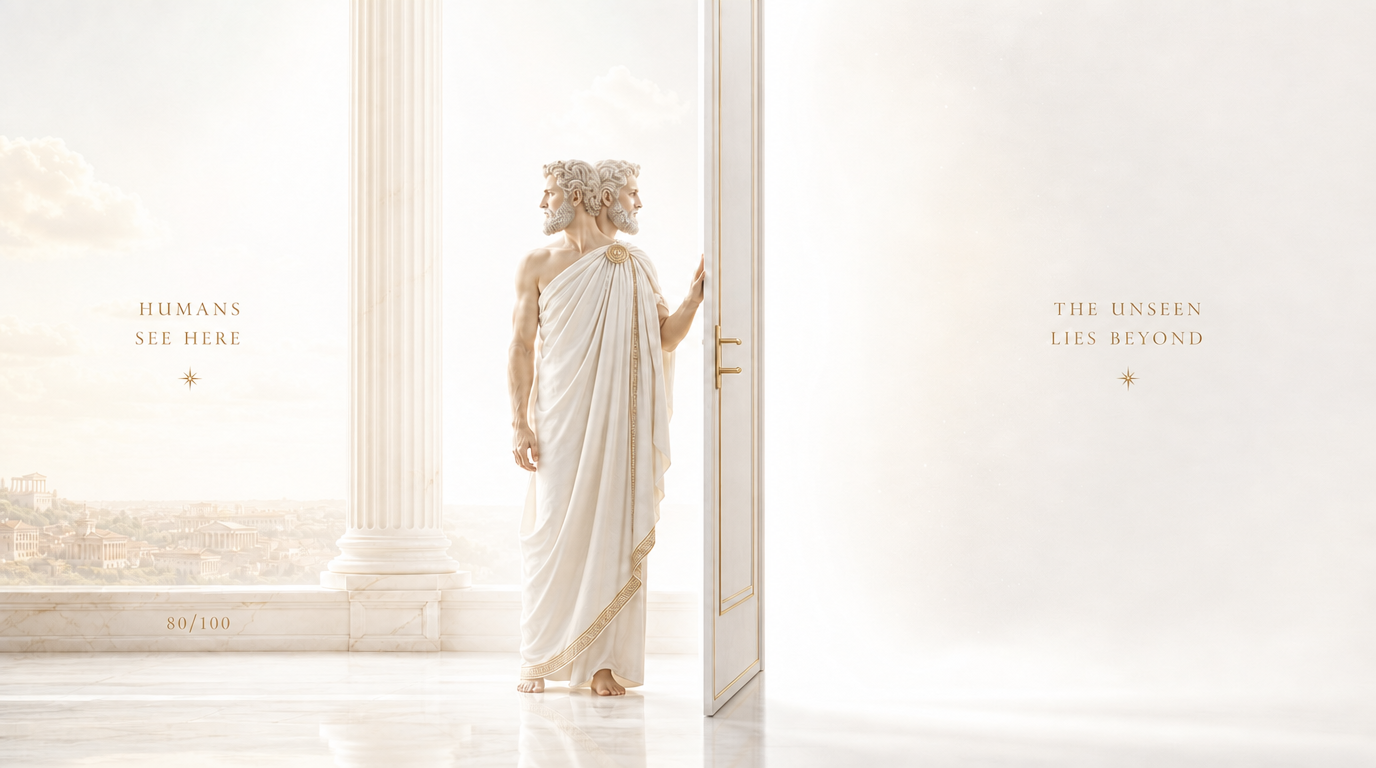
Janus is the god of doorways, gates, transitions and beginnings — January is his month, the hinge of the year. The Romans carved him with two faces on one head, looking in opposite directions at once, because a door has two sides and someone standing in it sees both. He wasn't a god you visited in a temple at the edge of town; his shrine stood at gateways, because his whole jurisdiction was the crossing itself.
The agent at the centre of Limen is named for him, and the job description is nearly a translation. One of Janus's faces reads the human web — your pages as your customers see them, the design, the story, the tone. The other face reads the machine web — the same pages as an AI assistant ingests them: the text that survives extraction, the structure, the signals of identity and trust. Most of what's broken about a site's AI visibility lives precisely in the gap between those two views. A page can be beautiful to one face and nearly blank to the other.
So Janus does what a doorkeeper does. He stands at the limen, reads both sides, and tells you — in plain language, finding by finding — what the machine-facing side is missing. The findings become fixes, the fixes become points, and the points walk you toward the tick at 80. He doesn't carry you across; it's your site and your hand on the door. But he holds it open, and he never pretends you've crossed when you haven't.
(He has his own introduction in this journal — Meet Janus: reading both webs at once — for the fuller portrait.)
Why the company is called Limen
By the time the product had a threshold, a scale and a doorkeeper, the company name had chosen itself.
Limen — the threshold. And the full domain says what we do with it: translimen.io, from trans, the Latin for across, through, beyond. Trans-limen: across the threshold. The name is a job description, the way a good tool's name should be. We take websites that are invisible to the machine web — a world most owners can't see, running silently alongside the one they built their site for — and we carry them across the line into it.
There's a quiet naming tradition at work here, too. Janus is Roman. Iris — who explains things — is Greek. Mechane is Greek. Limen is Latin. The family uses the classical languages without forcing uniformity; each name is picked for fit, not convention. It felt right that the company itself took the humblest, most literal word in the set — the one carved into doorsteps.
Not the god, not the messenger. The stone you cross.
And "threshold to a new dimension" is less mystical than it sounds. The machine web is simply a second readership — enormous, tireless, and increasingly the first thing your future customers consult. Below the limen, that whole dimension can't see you. Cross it, and you exist there. That flip — nothing to something, absent to present, unnamed to named — is the oldest idea in psychophysics and the newest problem in commerce, and it's the entire reason there's a tick on your score bar that refuses to move.
Crossing is a beginning
One last thing the Romans got right: Janus was also the god of beginnings. Crossing a threshold isn't the end of a journey; it's the start of being somewhere.
The dashboard treats it the same way. When your score crosses 80, the caption changes, the checkmark appears — and the dashed line stays on the chart, because the machine web keeps moving and the next scan keeps you honest. The twenty points above the limen are where presence turns into prominence, where being named turns into being named first.
But the tick at 80 will always be the number we care about most. It's the difference between a candle burning and a candle seen — and no amount of wax below the line ever added up to light.