
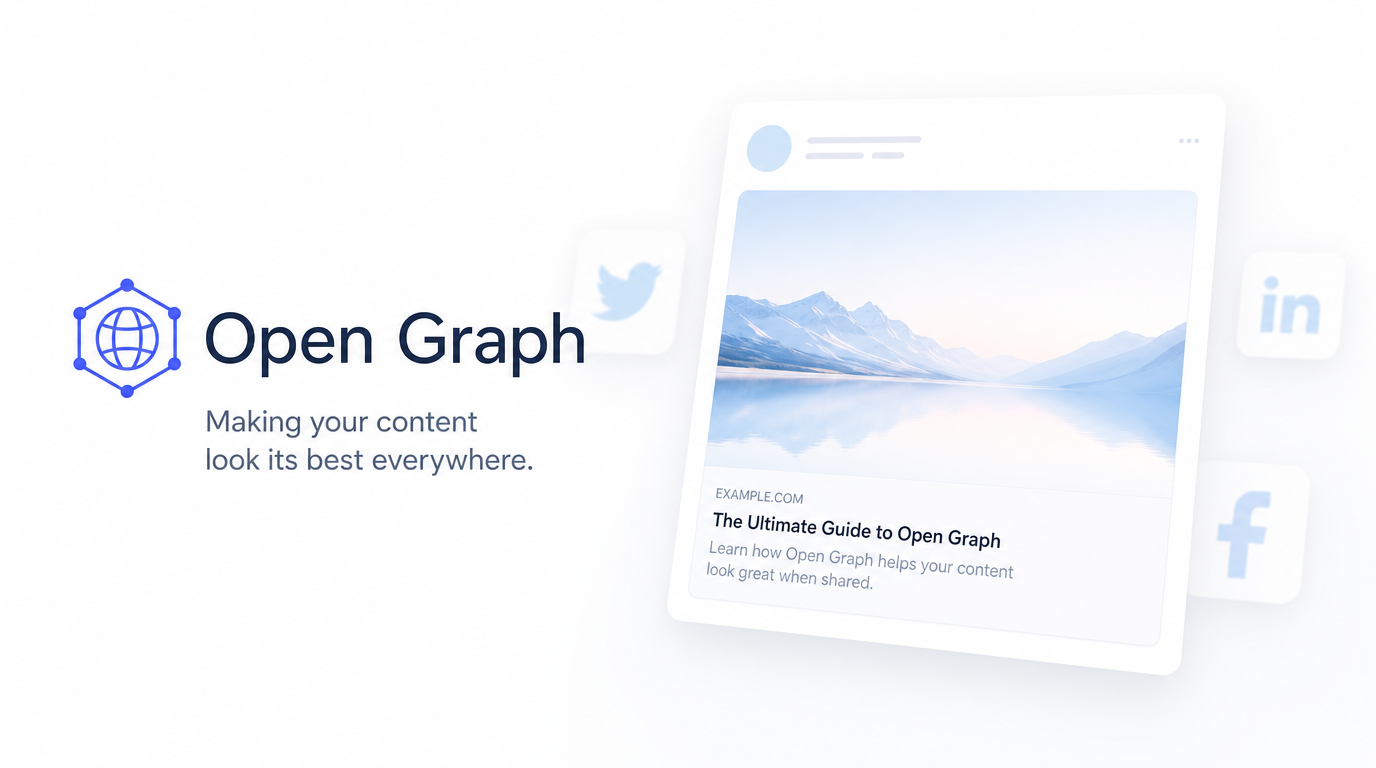
Let me show you something you have seen ten thousand times and never once looked at.
You paste a link into a message. To a friend, into a group chat, onto a social feed. A beat passes. Then a little card unfolds: an image, a headline, a sentence of description, the name of the site it came from. You did not make that card by hand. Something read your page and built it for the occasion.
That something has a name. It is called Open Graph, and once you can see it, you will never unsee it. Let's take a walk.
What Open Graph actually is
Underneath every web page sits a layer the visitor never reads. A set of quiet notes in the page's header, written not for humans but for the machines that pass through. Open Graph is a small, agreed-upon vocabulary of those notes. It lets a page say, plainly, four simple things about itself:
- What am I called? The title on the card.
- What am I about? The one-line description.
- What do I look like? The image that appears.
- Where do I live? The address the card links back to.
In the raw, it is unremarkable. Just a handful of lines tucked in the top of the page:
<meta property="og:title" content="The card you didn't know you were printing" />
<meta property="og:description" content="A short walk through Open Graph." />
<meta property="og:image" content="https://translimen.io/card.jpg" />
<meta property="og:url" content="https://translimen.io/open-graph" />
That is all. Four little instructions. But those four lines decide whether your link arrives dressed for the occasion or arrives as a bare, grey, nameless smudge that nobody trusts enough to click.
Where it came from
Here is the part I find quietly funny. Open Graph was not handed down by a standards committee after years of deliberation. It arrived in 2010, from Facebook, with a distinctly imperial ambition. The idea was to let any web page describe itself as an object in a great social graph, a book, a film, a restaurant, an article, so that the page could live inside the network as a first-class citizen rather than a mere link.
The grand vision mostly did not happen the way it was drawn. But the humble machinery underneath it, those four little notes, turned out to be enormously useful, and everyone quietly adopted it. Messaging apps read it. Social platforms read it. Slack reads it, and Discord, and iMessage, and WhatsApp, and LinkedIn, and the previews inside a hundred tools you use without thinking. A convention meant to build one company's empire became, instead, the shared handshake of the entire web.
I have watched a great many thresholds over the years. It is a familiar shape. Someone reaches for the whole kingdom, and the thing that endures is the doorknob they invented along the way.
How it is used today
Today Open Graph does one job, and it does it everywhere. It decides what your link looks like the moment it leaves your hands and appears in someone else's.
Think about what that means. You will almost never control the room where your link lands. It surfaces in a stranger's feed, a colleague's inbox, a customer's group chat, surrounded by other cards, competing for a half-second of attention. In that half-second, the card is your entire storefront. A sharp title and a good image, and the link looks like it was made by someone who cares. A missing image and a garbled title, and the link looks like a mistake, or worse, like something to avoid.
And here is the turn that matters now. People are no longer the only ones reading these cards. The machines that increasingly stand between a person and the open web, the answer engines, the assistants, the tools that summarise a page before a human ever visits it, lean on the very same structured notes to understand what a page is. The tidy self-description you write for a messaging preview is the same tidy self-description that helps a language model grasp your page at a glance. One small effort, quietly working two doors at once.
Why valid, current tags matter more than you would think
Now, the part where most people get quietly bitten.
Open Graph fails silently. That is the whole problem. When your tags are broken, or stale, or simply absent, nothing turns red. No error appears on your screen. Your website looks perfectly fine to you, sitting there in your browser. It is only out in the world, in the feed, in the chat, in the preview you never see, that the card comes out wrong.
The usual failures are mundane and merciless:
- An image that no longer exists, so the card renders grey and empty.
- A title left over from a template, something like “Home | My Site”, that tells a reader nothing.
- An old description from a page you rewrote a year ago, still introducing you as who you used to be.
- An image at the wrong dimensions, cropped by the platform into nonsense.
- Tags that were never there at all, leaving each platform to guess, and guess badly.
None of this shows up when you look at your own site. All of it shows up to everyone else. You could be sharing a broken card a thousand times a month and never once know, because the one person who never sees the card is you.
Your website is the one house you never see from the street. You only ever stand inside it. Everyone else meets it at the door, and the door is the card. Worth checking what is hanging on it, don't you think?
So open the door and look
You do not need to guess, and you certainly do not need to buy a dashboard with forty dials to find out. You need to see the card the world sees. Once. Clearly. Then fix whatever is wrong, if anything is.
So we built you a window.
It is free, and it is meant to stay that way. It is public, so anyone curious enough to check how their site looks out in the world is welcome to walk up and look. No sign-up stands between you and the answer. Paste your address, and the card the internet has been quietly printing on your behalf appears in front of you at last.
Almost no one bothers to check this. Which is precisely why checking it puts you ahead of almost everyone. You are standing at the door already. That is more than most ever do.
Go see your card. I will hold the door.