
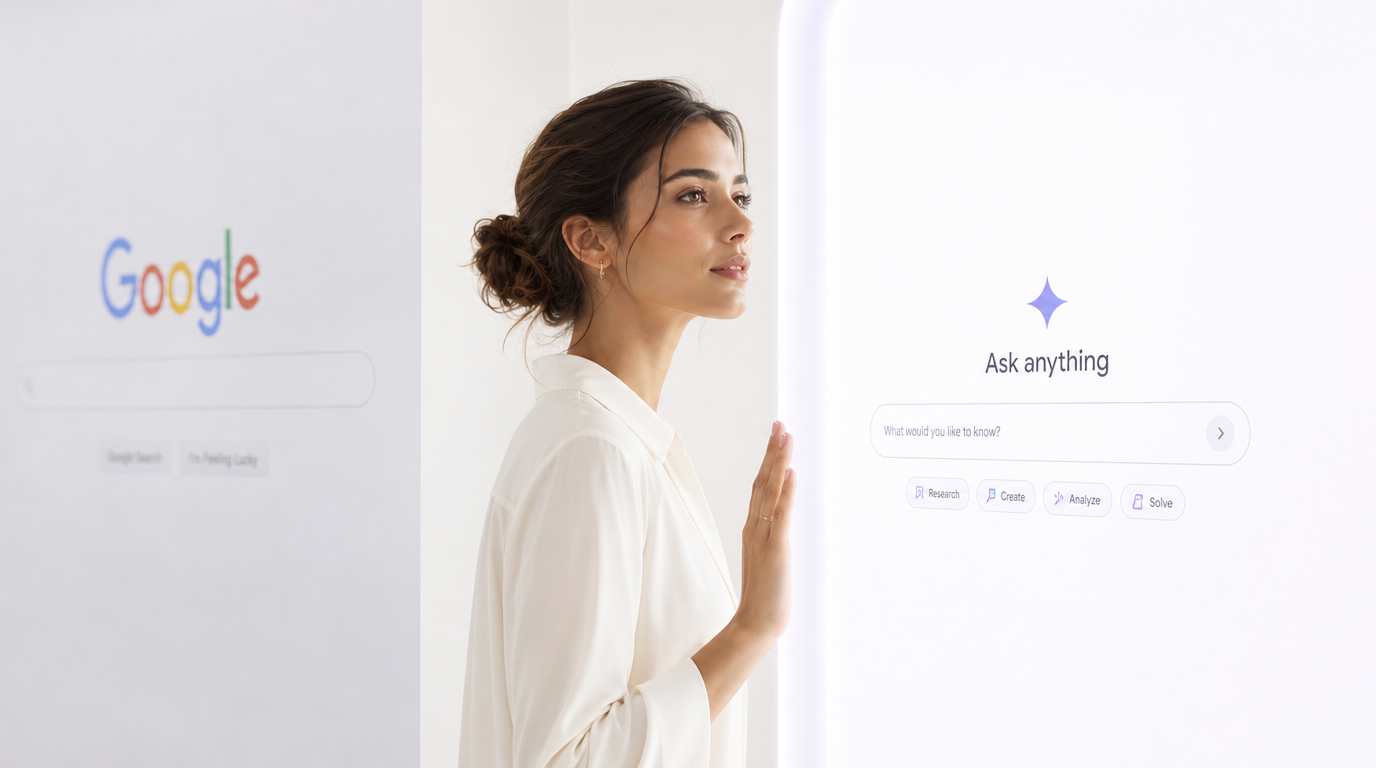
The story of how I got here is embarrassingly mundane. There was no lightning bolt, no conference talk, no chart going up and to the right. There was just a small moment, on an ordinary day, when I wanted to look something up, and I noticed my hands.
They didn't go to Google. They opened a chat window and typed a question.
That, by itself, is nothing. What stopped me was the follow-up question I asked myself: how long have I been doing this? I scrolled back through my history, honestly expecting to find a few weeks of this new habit. It was months. Months in which I had not run a single real Google search. Months in which every piece of information I'd gathered, for work, for curiosity, for buying things, had come from asking an AI a question in plain language.
I hadn't decided to switch. Nobody sold me on it. A revolution had happened inside my own daily routine, and I only found out about it afterwards, the way you notice a haircut in an old photo.
And here's the interesting part: I build things on the internet for a living. If I didn't notice the switch happening in my own hands, what are the odds that a busy shop owner, a physiotherapist, a small consultancy has noticed it happening in their customers' hands?
Asking beats searching, and it always will
Once you see the switch, the reason for it is almost insultingly simple: asking a question is easier than performing a search. Not slightly easier. Fundamentally easier.
Say I want to know how heavy the sun is, in kilograms. The old way: I type words into a search box, get back ten blue links, open two or three of them, dodge the cookie banners and the ads, skim until I find a paragraph that maybe contains the number. The new way: I ask, "hey, how heavy is the sun in kilograms?", and the answer is just there. One question, one answer, done.
Searching was always a workaround. What people wanted, from the very first day of the web, was to ask a question and get an answer. For thirty years the technology couldn't do that, so we all learned to speak in keywords and sift through result pages ourselves. We got so good at the workaround that we forgot it was one. Now the direct route exists, and human nature is doing the rest, because human nature always takes the easier path.
That's why I believe the replacement of search won't be a fair fight or a slow negotiation. It will follow the oldest pattern there is: slowly at first, then all at once. We are in the "slowly" phase right now. It won't last.
So what is AEO, actually?
You've probably heard of SEO, search engine optimisation. Even if you couldn't define it precisely, you know the gist: it's the craft of making your website show up when people google things related to your business. An entire industry has been built on it for over two decades.
AEO, answer engine optimisation, sometimes called GEO, generative engine optimisation, is the same idea for the new behaviour. It's the craft of making your business show up when people ask questions instead of running searches. When someone asks ChatGPT, Claude, or Gemini "who's a good accountant for freelancers in my area?" or "which tool should I use for X?", AEO is what determines whether the answer mentions you or mentions your competitor while you don't exist at all.
When I explain this to people, I rarely encounter misconceptions about AEO. I encounter something more basic: most people have simply never heard of it. They know SEO, at least as a word. AEO isn't misunderstood, it's unknown. That gap, between how fast the behaviour is changing and how few people have even heard the name for what to do about it, is the reason I'm writing this at all.
SEO gets you ranked in a list of links. AEO gets you named in the answer. In a world where nobody reads the list anymore, only one of those matters.
The invisible companies don't know they're invisible
Here's what makes this moment strange. Right now, the old world and the new world are running in parallel. Google search still exists and still sends traffic. So a company that has invested in SEO looks at its numbers and sees nothing alarming. The website ranks. Visitors arrive. Everything seems fine.
But run the other experiment. Take that same company, well-ranked, professionally built, SEO money well spent, and ask an AI the question its customers would ask. Very often, the company simply doesn't appear. Not ranked lower. Not on page two. Absent. The answer engine names three competitors and moves on, and the company has no idea, because there's no dashboard anywhere telling them how often the machines mention them, or don't.
As long as the two worlds run in parallel, this invisibility is painless. Companies won't feel it starkly until the switch happens. until the majority of their customers stop searching and start asking, the way I did without noticing. And by the pattern I described above, that moment won't arrive gradually enough to react to. The businesses that will do well are the ones who fix their invisibility while it's still painless, not after it starts costing them customers they never knew they lost.
What can a normal business actually do?
The honest answer depends on your budget.
If you have thousands to spend every month, this problem solves itself: you hire an agency, tell them to make your website visible to the answer engines, and the job is done. Agencies are waking up to AEO, and for large companies that route works the way it always has.
But most businesses aren't that. Most businesses are a solo founder, a family firm, a practice with three employees; people who don't have an agency budget and don't have a developer on staff, and who, when they look for help, find tools that speak fluent jargon at them and reports they'd need a translator to read.
That's the gap I'm building Limen into. AEO for a fraction of what an agency costs, explained in plain language, so you can see what the machines see when they look at your website, and fix it yourself, without hiring anyone. But this article isn't the place for a pitch, and frankly the advice stands with or without us: whatever service you choose, choose one that explains, not one that impresses you with vocabulary.
The revolution I'm describing isn't loud. It doesn't look like a revolution. It looks like millions of people, one by one, quietly forming a new habit they don't notice they've formed, the same way I did. Nobody will announce the day search dies. You'll just realise, one afternoon, that you can't remember the last time you googled anything.
The only real question is whether, by that afternoon, the machines answering everyone's questions know your business exists.